Showing posts with label sanibel. Show all posts

Wednesday, May 21, 2014

Green Turtle Crawl!


This morning was an interesting morning to be on the beach! We had our first green turtle crawl onto the beach ....early for a green turtle and she didn't dig a nest. Green turtles are uncommon on Sanibel.


The characteristic tail poke/drag is missing, and the front right flipper appears to be damaged, but you can tell it's probably a green because the flipper marks are slash like (rather than comma shaped) and symmetrical (rather than alternating like a loggerhead).Greens usually nest later in the  season as I mention, which makes this especially interesting.  Too bad it was a false crawl so we'll never be absolutely sure. FWC did confirm that they also thought it was a green turtle. It was fun to use field science to try and determine the species.

Another turtle, a loggerhead was caught finishing up her nest at dawn the other morning by another volunteer who provided pictures.


And the most exciting event of all was recorded by a Venice, Fl resident who spotted the rarest turtle of all the Kemp's Ridley digging a nest on Venice Beach on May 9. Check out this Youtube video.

 Kemp's Ridley Nests on Venice Beach

So Turtle Season is really gearing up!


Wednesday, May 7, 2014

My First Turtle Nest Officially Staked!!


I'm so excited! Turtle season has officially started, the turtles are finally coming in to nest, and I have gotten to stake a nest.  On Sunday I went out to the West end of Sanibel on the Gator vehicle. It was another beautiful morning, a bit on the cool side, but beautiful none the less. After loading the gator with supplies we drove down to Tarpon Bay road where we entered the beach. The sun was barely above the horizon but people were already setting up for the day, fishing and shell collecting. Riding a vehicle on the beach is a whole new experience. Parts of the beach are eroding and little shore birds are also nesting. You must drive, look for tracks, avoid large holes dug by enthusiastic children, miss little chicks and eggs, look for trash and not hit any tourists with the gator. Kelly, the turtle rescue coordinator, and I shared the responsibility. We were both excited and hopeful that we would at least spot a false crawl, but no luck.

Today we went out on the East end. Several more false crawls had been reported on Monday and Tuesday, a nest was also laid, so we expected to hear from the walkers on the East end that there had been some activity.  By 7 in the morning the calls from the beach walkers started to come in. Zone 6 had a nest!! Off we went, this time in a regular car to exam it and stake it.

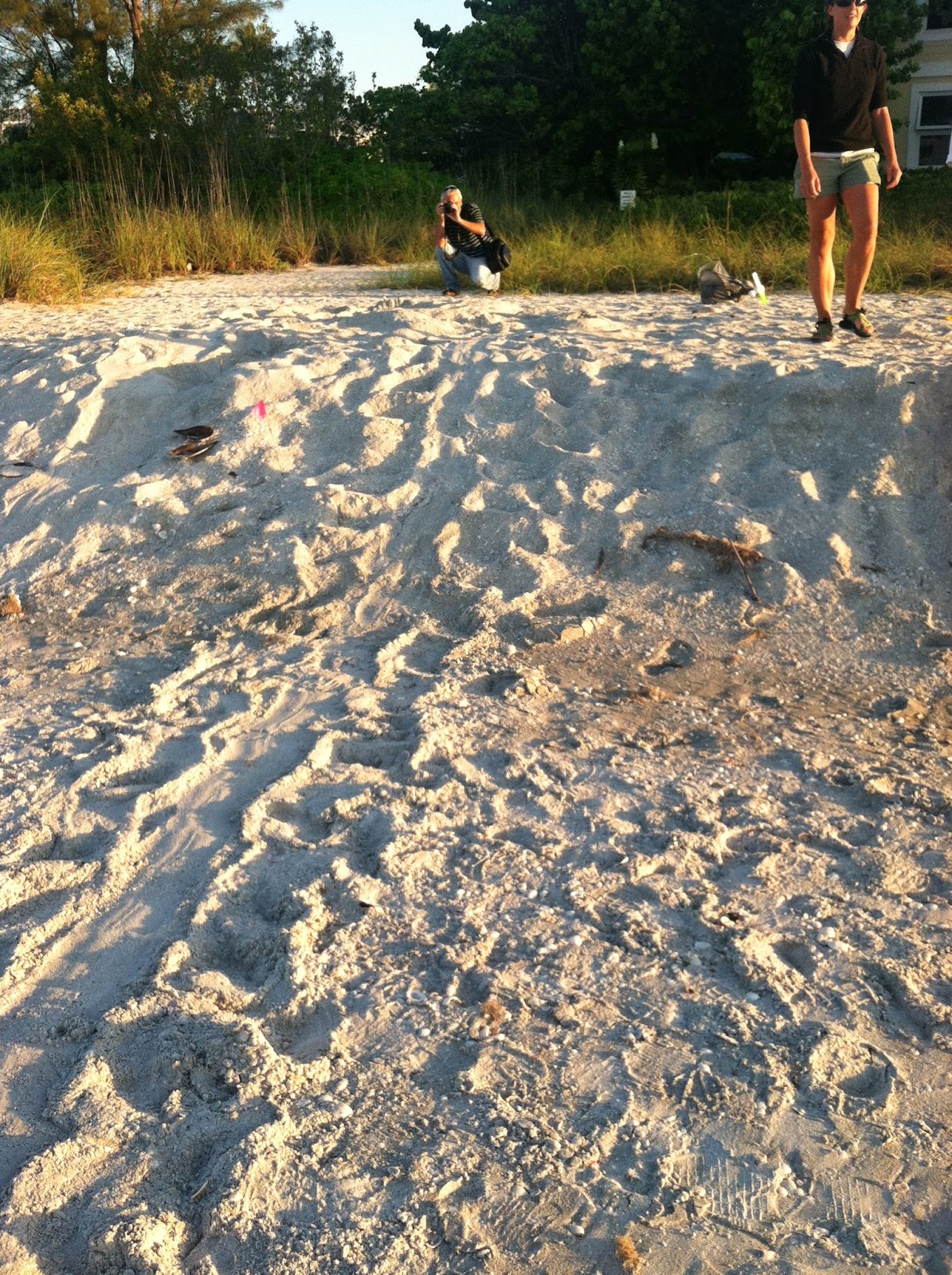
Looking at this section of beach, the first thing you notice is the gentle escarpment up from the tide line.


It was sloped enough that this momma turtle had no problem climbing up about two feet to lay her nest on higher ground. This was a good spot because only the highest storm tide will threaten this nest.

Kelly asked me which direction the tracks indicated where the turtle had entered and left the nesting site.  Of course I had it backwards. It's important to know direction so that you can estimate where the egg chamber is located. You don't want to accidentally place a stake in the egg chamber.


France was the walker who discovered the crawl. Kelly asked her to estimate where the egg chamber was located based on the signs left by the nesting turtle. It was interesting to discover that the chamber was actually not in what appeared as the deepest part of the body pit the turtle had dug. Rather it was to the right and back in an area she had spent time flipping sand onto.

We don't verify the egg chamber by probing for fear of damaging it, so a good estimate is essential when it comes time to excavate a nest after hatching or in case of a failure to hatch. You can dig a long time in the wrong spot.


We then laid out the stakes, marked the location, gathered relevant data to be recorded and taped the nest.

It was a great morning and I look forward to the rest of the season and the surprises, challenges, and adventures to come.


Saturday, April 26, 2014

Turtles!

The first turtle crawls have been spotted this morning on the West end of Sanibel....can a nest be far behind?


This lovely lady was spotted in Red Fish Pass yesterday off Captiva.

Wednesday, April 23, 2014

Spending the Day on Pine Island Sound- Part 1


We headed out early this morning to pick up our ride for the day- a twenty foot Grady White from Port Sanibel Marina.  Port Sanibel Marina is just before the causeway on the mainland and has a great kayak launch as well as various rental boats to fit any need. After going over the safety information, we headed out the channel.


The plan for the day was to explore the Sound with my 93 year old father. He's still going strong and loves to be outdoors doing anything and everything. The morning was a little cool and overcast-we had been hoping for a little more sunshine. The breeze was coming out of the north so there was a bit of a chop on the water. I covered my legs up with a towel, added several layers of shirts and jackets to keep the wind off.

To the West, we watched Sanibel Island slip by- you can always tell where Ding Darling is because the houses disappear and the coastline becomes mangrove. It's always a good idea to scan the water for manatee sightings and dolphins. Today didn't disappoint as a dolphin flipped his tail into the air and slapped the water not far from the boat...great fun!

Captiva Island comes next and you can identify the resorts of Tween Waters and South Seas Plantation. Crossing Red Fish Pass, North Captiva becomes visible. North Captiva can only be reached by boat and they like it like that! It's a great place to pull into for an ice cream on a hot summer day...but not today.


Cayo Costa Island is next and we pulled to the South end of the island where there is a sandy beach.  We contemplated anchoring and going ashore, but it would have been too difficult for dad to get out of the boat and climb back in on the ladder. There is great shelling on Cayo Costa and I prefer the south end. I just wasn't ready to get wet to do it today.  Instead, we decided to travel to the north part where there are docks in the state park, ride the tram and check out the beach.


The sun still refused to come out, but we enjoyed our walk on the beach. We even found a few sharks teeth. There aren't as many here as farther north toward Venice Beach, but you can still find them. Campers were out and about enjoying the day. If you decide to camp there, you can tent camp

 or rent one of the little cabins that have bunks and a picnic table....no other amenities. It's roughing it, but looked like fun.

I can imagine how wonderful the night sky must be so far removed from city lights. And dark, it would be very, very dark. We took the tram back to the docks and headed out to find Cabbage Key, passing the remains of an old stilt house that stood in the Sound until it burned about twenty years ago. It was just like these just a few that are still  left in the Sound.


I'll leave off here and post the second half of our day on the Pine Island Sound.


Sunday, April 6, 2014

Kayaking J.N."Ding" Darling Wildlife Refuge

Sanibel offers many delights. Beaches abound and shelling is world famous. For a real treat, find a kayak to use to explore around the many mangroves, bays and quiet shorelines. There seems a limitless opportunity on Sanibel to explore quiet retreats where you can observe nature and its secrets.

One of our favorite places to kayak is Tarpon bay and the waters around the J.N. "Ding" Darling Wildlife Refuge. There are two places where it is easy to launch a kayak from wildlife drive. From there, you can paddle secluded bays and mangroves.


Birds are usually abundant in the refuge. There are many species that live there and others that migrate through the refuge during the year. It can be fun to observe what hides in the quiet areas, secluded from wildlife drive. If you keep conversation to a minimum and listen for bird calls you might even spot a rare bird...the mangrove cuckoo.

Mangrove Cuckoo

It is also possible to spot creatures other then the birds that call the mangrove marshes home. For instance there is  the little mangrove crab, one of only two crustaceans that climb trees as a defense mechanism.


Mangrove Salt Marsh Water Snake


Another critter to hide among the limbs of the mangrove is the Mangrove Salt Water Marsh Snake. It is a non-venomous snake not found outside of Florida.


Green Heron

White Egret in Breeding Plumage by Joe Jennelle

Kayaking at low tide in the refuge provides the best opportunity to spot wading birds and the springtime show of breeding plumage can be a magnificent sight. Use binoculars to get a better view. Document your sightings by taking a picture so bring along that camera. And when you return home there are an abundance of sites online that can help you identify what you have seen. 

Birding is a sure way to add to the enjoyment of the refuge. Keep a list of the birds you've seen and share them with others on ebird.org. A very useful app for your phone is the Merlin Bird Id app which is free from the Cornell Lab of Ornithology. With this little app, you can enter size, color, and location. The app will give you images of possible birds from which to id the sighting. 


Little Blue Heron in His Best Colors!


We also belong to a kayak team in Ding Darling called The Monofilament Busters.


Monofilament Busters
Every Friday, teams of volunteers take to the waters of J.N. “Ding” Darling National Wildlife Refuge on Sanibel to remove the nearly invisible monofilament fishing line that can be deadly to birds and marine life.   A steady crew of six volunteers hit the kayaks weekly. And on a single day, here’s everything hauled in by the Refuge Teams:

monofilament line
19 hooks
8 lead weights
12 non-lead weights
2 bobbers
7 jigheads/stump jumpers
1 fly
5 lures
1 spoon

Removing these hazards is important to the refuge and other areas as fishing line and hooks are dangers lurking to trap unsuspecting wildlife. It is a tragedy waiting to happen and there is nothing more distressing than to spot a dead bird trapped by fishing line or impaled with hooks from a fishing lure.


Entangled in Monofilament-Spoonbill and Egret

Here is one last important note. Although kayaking in the refuge is a wonderful experience, it is a wilderness area and possible to get lost.  So it is important to pay close attention to your surrounding as the streams between the mangroves twist and turn. They  can confuse even the most experienced kayaker. A GPS makes a lot of sense for navigating the waterways. A good bug repellent to protect from the occasional mosquito and the nefarious "no see 'um" is also a good idea. Sun protection in the form of a good hat and sunscreen will make for a more enjoyable experience too.

So take out that kayak and discover hidden treasures in the waterways of the J.N."Ding" Darling Wildlife Refuge. You won't be disappointed.


Tuesday, April 1, 2014

The Green Flash

Green Flash

Ask people about the green flash on Sanibel and they are likely to think you are referring to a restaurant by that name on Captiva Island. Or they might think it is just the stuff of legend and not a real phenomenon at all. A third possibility is that they declare they have seen it after downing several margaritas at sunset on the beach. For the few sky gazers who have actually witnessed the event, they will defend their sighting ignoring ridicule and laughter. I fall into the last category.

Take to the beach at sunset, hope for a clear horizon with calm seas and wait. I have been fortunate to observe the green flash three separate times in my life, the last two times in the past month right on the beaches of Sanibel. Each time there have been others who observed it as well, insuring it wasn't an overactive imagination on my part.

Last night was my third opportunity to witness the event and was fortunate to be with an actual astronomy professor from Canada who has been determined to capture the green flash on camera. That requires real dedication as most evenings do night produce a green flash.  If it did, it wouldn't be such an alluring event. He sets up his camera on a tripod and hopes. Some evenings the camera can capture what his eyes did not. Other evenings the opposite occurs.
Green Flash

According to the professor, the science behind the green flash involves refraction of light and inferior mirage effect. Really?  Ok, but I say, just take to the beach at sunset, and keep an eye out for the green flash. The magic is there. And if you miss it, at least you were on the beach at sunset and you might even see something like this!
Last night right before the green flash...calm and clear.

Sanibel Sunsets never disappoint.


Monday, March 31, 2014

Turtle Time Begins!


Welcome to my Sanibel Island Blog.  We have been living here full time for almost two years now. Sanibel has proven to be a truly wonderful place to call home.  In this blog, I will share the unique and special events that define the Island and the folks who live here.

Today I am excited because my training to become a permittee for the Sea Turtle Monitoring Program with SCCF (Sanibel Captiva Conservation Society) begins this week. I have wanted to be involved in conservation for this endangered species and living on Sanibel is perfect for easy involvement.

Last summer Michael and I volunteered to walk a zone on the East end of the Island. This meant getting up before dawn to be down on the beach by sunrise.
Walking our section of beach at sunrise
 It's important to arrive before the Island starts to awaken, but no matter, there was always someone walking, fishing, jogging or setting up for a day at the beach! As we walked our section, we looked for signs of loggerhead turtle tracks. Loggerhead turtles are the most common sea turtle to nest on our beaches. Most days were unproductive- no signs of false crawls where the female comes ashore but fails to lay eggs,
False Crawl Loggerhead Turtle Sanibel

 No signs of successfully laid nests. By mid season however there were about four nests in our small section of beach to monitor for the program.
Marked and Monitored

It was a great experience and I was eager to expand my participation. So this year, I am in training to do more. I'll share my experience as it unfolds and it should be rewarding and educational. Come along with me on this journey and learn more about sea turtles and Sanibel Island, Florida!
Loggerhead Sea Turtle